Understand the Choice Behind Each Mechanism
When someone says they "don't like resource games," they rarely mean they dislike wooden sheep or brick tokens. Usually, they mean they disliked the feeling of being locked out of an action space in a harsh worker-placement game, or they grew bored waiting while another player shuffled a thirty-card deck. Understanding game mechanisms lets you diagnose why a session succeeded or fell flat—and how to make smarter decisions inside each system.
Worker Placement: Action Drafting in Disguise
Popularized by designs like Caylus (William Attia) and Agricola (Uwe Rosenberg), worker placement turns the game board into a shared menu of actions. When you set your wooden disc on "Take 3 Wood," nobody else can use that spot for the rest of the round. Unlike direct combat where an opponent destroys something you already own, worker placement creates pre-emptive denial: they simply got to the bakery before you did.
Modern variations soften or sharpen this tension in clever ways:
- Bump-and-Pay Spaces: In Viticulture (Jamey Stegmaier and Alan Stone), a special "Grande Worker" allows you to use an occupied action space even after rivals have filled the normal slots, preventing total lockouts for newer players.
- Escalating Cost Spaces: In Keyflower ( Sebastian Bleasdale and Richard Breese), you can still use an action someone else claimed, provided you place one more worker of the matching color than the previous player.
Strategy Principle: Value the Turn-Order Space Properly
New players treat the "Claim Starting Player" space as a consolation prize when their favorite resource spot is gone. Experienced players calculate whether going first next round guarantees them two contested spots worth far more than a single pile of clay today.
Deck Building vs. Hand Management
When Donald X. Vaccarino released Dominion in 2008, he turned the collectible card game prep phase into the entire game: everyone starts with the same weak ten-card deck of copper coins and estates, buying stronger cards into their discard pile that get shuffled back into circulation. Pure deck building rewards probabilistic thinking—knowing that adding too many "terminal action" cards will cause your five-card hand to clog.
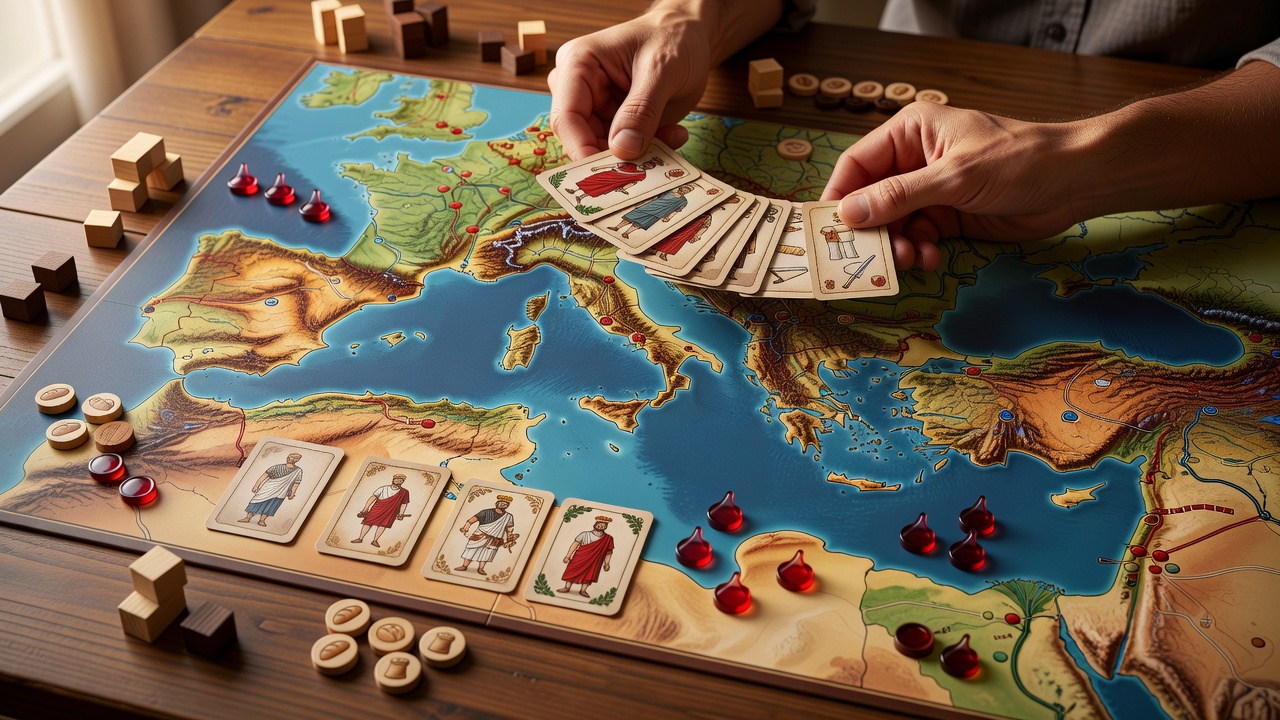
Compare that with hand-management cycling in Mac Gerdts's Concordia or Vlaada Chvátil's Mage Knight. In Concordia, you never shuffle your played cards. Every card you buy goes straight into your hand, and you hold complete control over the exact sequence of actions until you play your Tribune to pick them all back up. If your group dislikes the luck of drawing five coins and zero actions on a critical turn, hand-management cycling provides the satisfaction of building a personal toolkit without shuffle variance.
Auctions and Closed Economies
Why do veteran groups still pull out Reiner Knizia's Ra or Friedemann Friese's Power Grid twenty years after publication? Because auctions outsource game balance to the people sitting at the table. In a fixed-cost game, the designer decides that a power plant costs 12 coins; if the designer miscalculated and that card is actually worth 18 coins, whoever draws it first gains an unfair edge. In an auction game, if a tile is worth 18 coins, your friends will bid you up to 17 coins before letting you have it.
"In a closed-economy auction, you are never trying to buy a tile for what it is worth to you. You are trying to force your neighbor to pay one coin more than it is worth to them." Table Valuation Rule
Side-by-Side Comparison of Six Core Engines
| Mechanism | Player Interaction Type | Best Player Counts | Mental Load Profile | Exemplar Titles |
|---|---|---|---|---|
| Worker Placement | Indirect blocking over shared public spots | 2–4 Players | Sequencing actions & reading rival needs | Agricola, Viticulture, Lords of Waterdeep |
| Deck Building | Race for market cards & pace milestones | 2–3 Players | Card synergies & deck density ratios | Dominion, The Quest for El Dorado |
| Hand Cycling | Board positioning & copycat timing | 3–5 Players | Multi-turn cadence & reset timing | Concordia, Century: Spice Road |
| Open Auction | Direct valuation bluffs & cash squeezing | 3–5 Players | Opponent bankroll tracking | Ra, Modern Art, Power Grid |
| Route & Network | Shared infrastructure & spatial choke points | 3–5 Players | Map reading & tactical blocking | Brass: Birmingham, Hansa Teutonica |
| Tile Laying | Open drafting & shared border scoring | 2–4 Players | Geometric pattern recognition | Carcassonne, Cascadia, Azul |
Matching Mechanisms to Your Group's Evening
Notice how player counts shift across the table above. Deck-building and multi-step tableau games shine at two or three players where you can admire your engine without waiting fifteen minutes between turns. Auctions and route-network games blossom at four or five players where scarcity creates lively table talk. Ready to choose between working together or squaring off? Visit Game Selection to match these mechanics to your next session.