Choose Cooperation or Competition Deliberately
Many hosts treat cooperative games as the "safe, relaxing" option for mixed-experience groups and competitive games as the "cutthroat" option. In practice, the opposite is often true. An open-information cooperative game with one loud strategist can feel far more stressful for a newcomer than a gentle competitive tile-laying game where everyone builds their own garden undisturbed. Choosing well means matching the social posture of the game to the personalities in the room.
When Cooperative Games Shine—and How They Break
Cooperative tabletop designs replace an human adversary with an automated deck or crisis engine. When they work, the entire room leans forward before flipping an infection card in Pandemic or an invader card in Spirit Island. However, every host must evaluate how a cooperative game handles information asymmetry.
If every card and resource sits face-up on the table, the group is essentially solving a single optimization equation together. If one friend calculates math faster than the others, they will naturally start pointing at the board: "Sarah, move your piece to Atlanta and pass me that blue card." To prevent this quarterbacking dynamic without policing your friends' enthusiasm, choose one of three modern cooperative architectures:
- Restricted Communication Co-ops: In The Crew: Mission Deep Sea (Thomas Sing) or Sky Team (Luc Rémond), rules forbid you from discussing the cards or dice in your hand. You communicate strictly through playing a card or placing a die, preserving 100% personal agency.
- Simultaneous Asymmetric Co-ops: In Spirit Island (R. Eric Reuss), each player manages a unique hand of powers simultaneously during the Spirit Phase. Because everyone's personal board is already demanding their full attention, nobody has spare bandwidth to play someone else's turn.
- Narrative Deduction Co-ops: In Sherlock Holmes Consulting Detective, there is no mathematical move optimization—only group debate over clues, alibis, and timelines.
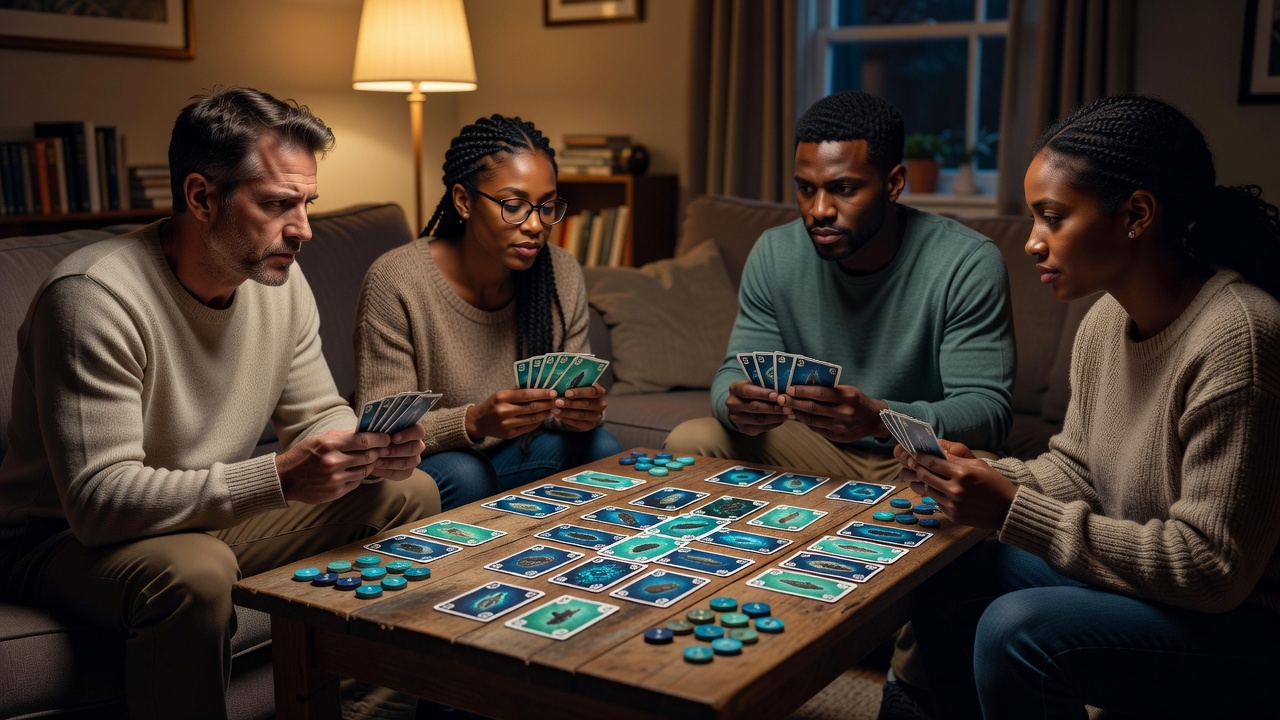
Three Flavors of Competitive Play
Not all competition feels the same across the table. When your friends say they want a competitive game, clarify which of these three textures they actually want tonight:
Players draft from a shared market, but once a tile or card enters your personal area, nobody can destroy or steal it. Examples: Cascadia, Wingspan, The Castles of Burgundy (Stefan Feld). Ideal when players have different skill levels or want to chat while building something tangible.
Players compete fiercely for turn order and map positions, yet your moves often benefit a neighbor alongside yourself. Examples: Brass: Birmingham, Concordia, Hansa Teutonica. Ideal for groups that enjoy reading opponents' body language without destructive "take-that" cards.
One player's gain is directly subtracted from another player's position on the board. Examples: Root (Cole Wehrle), Tigris & Euphrates (Reiner Knizia), Inis (Christian Martinez). Requires a group where everyone knows the rules equally well and laughs off a sudden upheaval.
The Player-Count Matrix for Adult Game Nights
Ignore the wide "2–5 Players" marketing badge on the side of the box and pick games engineered for the exact number of chairs you are filling tonight:
| Chair Count | Best Cooperative Fit | Best Competitive (Low Conflict) | Best Competitive (High Interaction) |
|---|---|---|---|
| Exactly 2 Players | Sky Team (20 mins, silent dice placement) | The Castles of Burgundy / Cascadia | 7 Wonders Duel / Targi |
| Exactly 3 Players | Spirit Island (deep simultaneous powers) | Wingspan / The Quest for El Dorado | Dune: Imperium / Tigris & Euphrates |
| Exactly 4 Players | The Crew: Mission Deep Sea | Azul / Carcassonne | Brass: Birmingham / Hansa Teutonica |
| 5 Players | Just One (light word deduction) | 7 Wonders (simultaneous card drafting) | Concordia / Ra / Hansa Teutonica |
Still Torn Between Two Boxes?
Check our detailed essays on Game Reviews, browse common hosting dilemmas on Table Questions, or use our Table Inquiry Composer to send us your group's profile.